Example workflow Receiving

How a Small Business Can Check Incoming Deliveries Against the Purchase Order

Import the order, scan every box on the pallet, and get one file with each item, how many boxes arrived and what was ordered. No extra scanner hardware needed.

This page shows how DataScan can be set up for this task. It is an illustration, not a report about a specific customer. All codes and values on it are examples.

7-Day Free Trial • iPhone, iPad & Android • Cancel Anytime
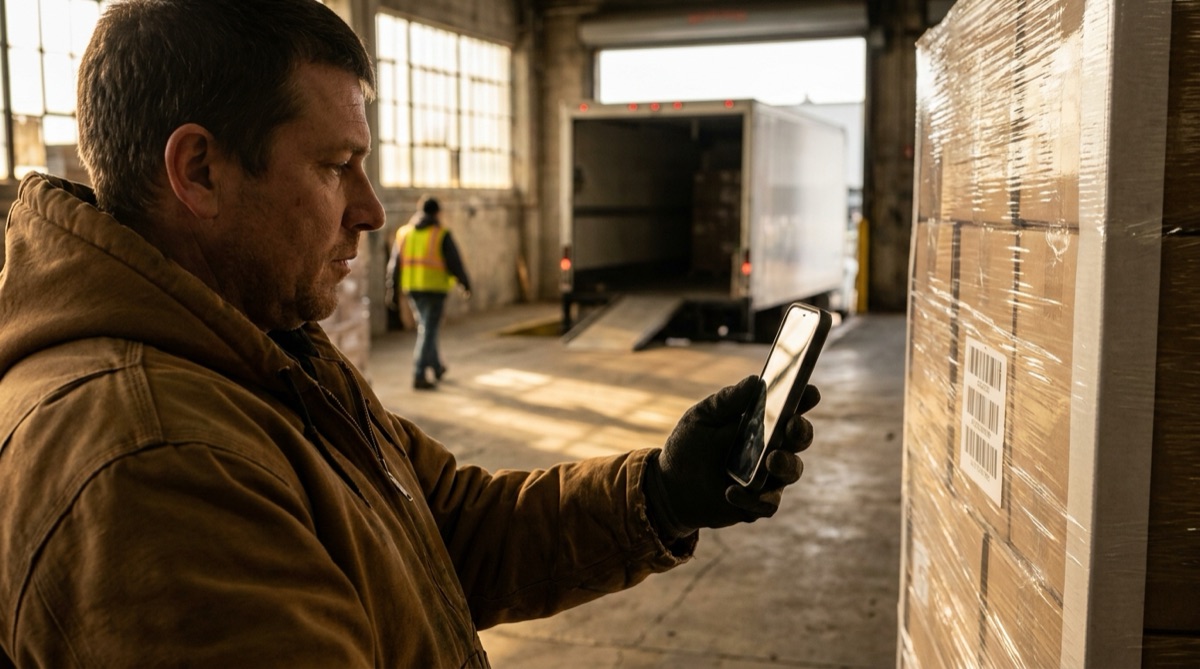
Warehouse employee scanning delivery boxes on pallet for verification

The problem

A pallet arrives, the driver wants a signature, and somebody has to decide quickly whether the delivery matches the order. Counting boxes by hand and ticking lines on a printed purchase order is slow, and with forty similar cartons it is easy to tick the wrong line.

Mistakes found a week later are hard to claim. The supplier asks when you noticed, the paperwork has been filed, and nobody remembers whether three or four cartons of one item came in.

What helps is a quick, complete record of what was on the pallet, made while the delivery is still at the door, with the order data right next to it.

The setup

Continuous Scan records every box. The purchase order is imported as lookup data, so the pop-up shows the item description while you scan and the export carries the order line next to each barcode.

Scan mode Continuous Scan
Lookup data The purchase order or advance shipping notice as a comma-separated CSV: barcode first, then description and ordered quantity. Imported in Lookup Scan from a file or a URL
Enable Cross-Reference On, so a pop-up shows the item description after each scan
Cross-reference with Lookup Data On, so the order columns appear next to each barcode in the export
Summarize Duplicate Scans On, so the export has one row per barcode with the number of boxes
Barcode Types The types on your cartons, for example EAN-13 and Code 128
Delete Data After Export On, so the next delivery starts with an empty list

Step by step

  1. Import the order Export the purchase order from your system as CSV with the barcode in the first column and import it in Lookup Scan. Before the next order, tap Clear Lookup Data and import the new file.
  2. Scan every box Open Continuous Scan and scan each carton on the pallet. The pop-up shows the item description for every barcode on the order.
  3. Pause when needed Touch and hold the screen to pause scanning while you turn a carton or move to the next layer.
  4. Export the delivery Export the session as CSV or Excel and send it by email, save it to Files or upload it by SFTP with a tap.
  5. Check it against the order Open the export next to the purchase order. The Count column beside the Ordered column shows every line that came in short or over, and your file is a timestamped receiving record for the supplier.

What you get out

With the summary and the order columns switched on, each barcode becomes one row:

Column Example value What it holds
Barcode 4006381333931 The carton barcode
Count 6 How many boxes with that barcode were scanned
First Scan 2026-03-14 10:02 Time of the first scan of that barcode
Last Scan 2026-03-14 10:09 Time of the last scan of that barcode
Description Garden hose 25 m From your order file
Ordered 8 Ordered quantity from your order file

The Description and Ordered headers come from your own CSV, so the file reads like your purchase order.

Fits well if…

  • Your cartons carry barcodes that also appear in your purchase orders.
  • Your system can export a purchase order or shipping notice as CSV.
  • You want a timestamped record of each delivery, made at the door.
  • You check deliveries in Excel or Google Sheets.

Check Your Next Delivery With Your Phone

Import one order, scan the pallet, and open the export next to the order. Every feature is in the free trial.

7-Day Free Trial • iPhone, iPad & Android • Cancel Anytime