How to Get Barcode Scans Into SAP or QuickBooks (CSV Import)
A simple way to get mobile barcode scans into SAP or QuickBooks is a file: scan with a phone app, export a CSV or Excel file shaped the way your system's import routine expects, and let the routine do the posting. DataScan captures the scans, formats the file, and uploads it to your SFTP server with one tap — no scanning licenses, no middleware subscription, no API project.
Mobile scanning without an integration project
Mobile scanning that posts directly into SAP or QuickBooks usually means an add-on product, dedicated devices and an integration project. For a warehouse doing a weekly count or a shop receiving a few pallets a day, that is often more than the job needs.
Your system already knows how to import a file. SAP has had batch input and file-upload routines for decades; QuickBooks imports Excel and CSV out of the box. The only missing piece is capturing accurate scans on the floor and delivering a clean file — which is a phone-app problem, not an ERP problem.

Scan to CSV to SAP or QuickBooks: step by step
- Define the file your system needs Before touching the app, ask whoever owns the import which columns, headers, delimiter, and date format they expect. An SAP physical-inventory upload might want material, quantity, count date; a QuickBooks item import wants its own header names. Ten minutes with the right person here saves every export later.
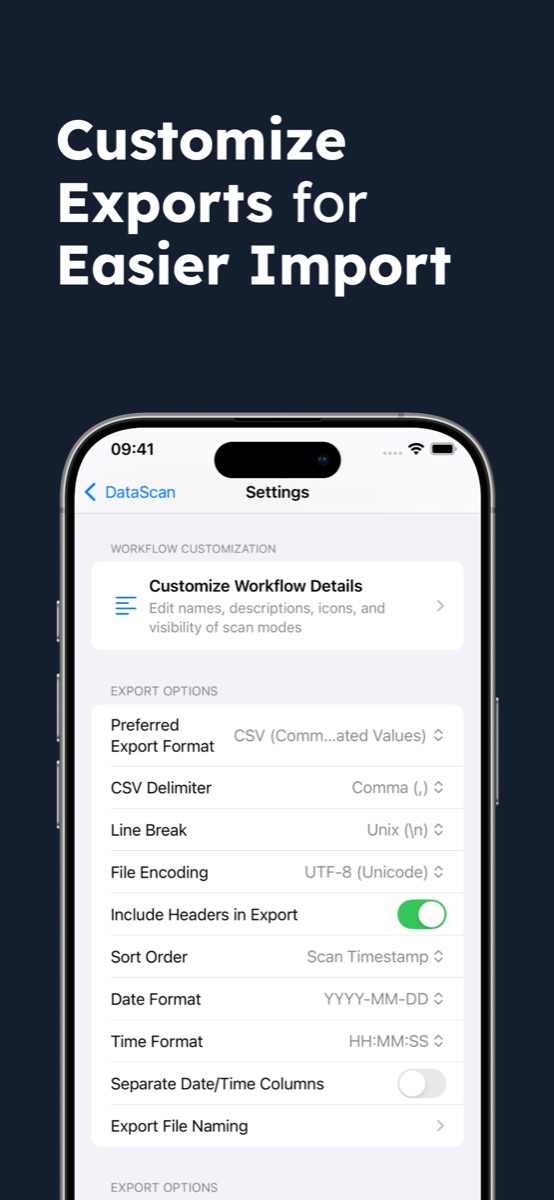
- Configure DataScan's export to match In Settings, set the export format (CSV or Excel), CSV delimiter (comma or semicolon), line breaks, and date and time formats. Then rename the column headers the app lets you rename: the barcode column (to Material or SKU, whatever the spec says), the quantity or count column, and in One-to-Many the primary and secondary columns. This is one-time work: every export from then on has the same layout.
- Scan with the mode that fits the job For inventory counts feeding SAP or a QuickBooks adjustment, use Single Value Scan — scan the barcode, type the counted quantity, one row per item. For plain lists (serials, received cartons), Continuous Scan is faster. If you first export a master list from your system, Lookup Scan verifies each barcode against it as you go — see the guide on verifying scans against a product database.
- Deliver the file Export the session and pick the route: upload via SFTP straight to a server folder, email through your own SMTP server, or share the file to any app on the phone. Each session gets its own file name; a date-and-time suffix under Export File Naming keeps the files in order.
- Import into SAP or QuickBooks Run the routine your system already has. In SAP, that is typically a batch input session or an LSMW-style upload for inventory counts — or simply handing the file to the team that owns those transactions. In QuickBooks, use the built-in Excel/CSV import or paste the rows into an inventory adjustment. Either way, the data posting is done by the system's own, supported mechanism.
- Verify the posting Spot-check a few imported records against the session on the phone. The row count and per-scan timestamps make it easy to confirm the whole file arrived and show when each item was scanned.
SFTP: the quiet automation win
If your organization runs any integration middleware — or even a plain scheduled job — a watched folder is the classic pattern: files that appear in the folder get validated and imported automatically. DataScan uploads a finished session to an SFTP server when you tap Save to Server, which turns the workflow into scan, tap Save to Server, done. The warehouse never touches a computer. Each session gets its own file name; add a date-and-time suffix under Export File Naming so the import job can pick files in order.
This is also the honest ceiling of the approach, stated plainly: it is file-based, not real-time. Scans post when the file is imported, not the instant the barcode is read. For receiving checks, counts, audits, and adjustments — the jobs where a human reviews the data anyway — that latency costs nothing. If you need every scan to hit SAP within seconds (conveyor sortation, real-time picking), that is what the certified live-connection products are for, at their prices.
What to tell your IT department
- No vendor cloud for scan data. Scans are stored on the device and travel only through channels you choose — your SMTP server, your SFTP server, or the share sheet.
- No accounts, no ads. The app needs no registration and sends no scan data to us.
- Works offline. Scanning needs no connectivity at all; the network is only involved at export time. Racking aisles and basement stockrooms are not a problem.
- Nothing touches the ERP directly. The import runs through your system's own supported routine, with whatever validation your team already applies.
- Same setup on every phone. A settings file copies the configuration to other devices, so ten phones in receiving all produce identical file layouts.
Field-naming tip: make the app match the system, never the other way around. Set DataScan's renamable column headers to your import spec's field names, use an unambiguous date format like YYYY-MM-DD, and prefer semicolon delimiters if your ERP templates come from European Excel installs. A file that imports with zero manual edits is the whole point.
What this looks like in practice
For stockroom counts the loop looks like this: Single Value Scan per zone, semicolon-delimited CSV with the material-number header the SAP upload expects, SFTP upload, batch import — the manufacturing parts inventory example workflow shows a related setup. The same file discipline covers receiving against purchase orders (see warehouse receiving with a phone scanner) and plain spreadsheet work — the scan-to-Excel guide covers the format details, including the scientific-notation trap with long numeric barcodes.
Other ways to connect scanning to SAP or QuickBooks
For completeness: SAP-certified mobile scanning suites (and SAP's own Fiori inventory apps) post transactions live and handle directed workflows — the right tool for high-volume operations that can justify per-device licensing and an integration project. QuickBooks-integrated inventory SaaS adds live sync plus purchasing features for a monthly per-user fee. Keyboard-wedge scanners type barcodes into whatever field is focused — fine at a fixed station with the ERP screen open, but they capture bare barcodes only, with no quantities, timestamps, or file trail. The phone-plus-CSV loop sits in the wide middle: mobile capture with structured data, at app-subscription cost, using import machinery you already own. Start with the DataScan overview to see all five scan modes — every feature is included in the 7-day free trial, so you can prove the full scan-to-import loop before spending anything.
Frequently Asked Questions
No — and that is deliberate. DataScan exports files (CSV or Excel) that your system imports through its own routine, or picks up from an SFTP folder after you upload the file. There is no live API connection, no middleware, and no vendor cloud between your scans and your system.
Export the scan session as CSV with the columns your SAP team specifies, then hand it to their existing upload path — typically a batch input session or LSMW-style recording for physical inventory counts, or a Z-transaction your team already uses for file uploads. If your organization runs integration middleware, uploading the file by SFTP into its watched folder lets the middleware take over from there.
Yes, via spreadsheet import. QuickBooks (Online and Desktop) imports lists and transactions from Excel or CSV files. Scan your stock with quantities in Single Value mode, export the file, and your bookkeeper imports it or pastes it into an inventory adjustment. You can rename the barcode and quantity column headers to the names your import expects and map the other columns in the import step.
That is for your IT team to decide; these are the facts they usually ask for. DataScan scans offline, requires no user accounts and shows no ads. It sends no scan data to us, only anonymised usage statistics and crash reports. Exports travel only through channels you choose — your SMTP server, your SFTP server, or the share sheet.